An honest decision framework rather than a sales pitch — including the situations where we tell people not to spend anything at all.
Tell us the job in 30 seconds. No pushy sales, no call-out fee.
Repair if the roof has ten or more years of service life left and faults are isolated. Replace if remaining life is under five years and repairs exceed £300 a year, or if more than about 30 per cent of the covering has failed. Between those, a survey decides.
The most expensive roofing mistake is replacing a roof that needed repairing, and the second most expensive is repairing one that needed replacing. Here is how to tell them apart.
Penenden Heath, Park Wood, Coxheath, Larkfield, Shepway and Senacre were built between roughly 1958 and 1978 with concrete interlocking tiles now at 45 to 65 years against a 30 to 50 year design life.
The useful measure is the proportion of tiles showing exposed aggregate. Under 25 per cent and there are years left, so targeted repair is right. Above 30 per cent and repair frequency climbs steeply because the tiles around each repair are failing too — that is where replacement becomes the cheaper option per year.
Properties on this stock built before 1975 have largely crossed the line already. We still survey each one rather than assuming, because a sheltered north-facing slope can be markedly better than the exposed south-west elevation on the same house.
Key FactBRE (Building Research Establishment) service-life data gives concrete interlocking roof tiles an expected life of 30 to 50 years and natural slate or clay tile 60 years and beyond, with fixings and lead flashings frequently reaching end of life before the covering itself on historic roofs.
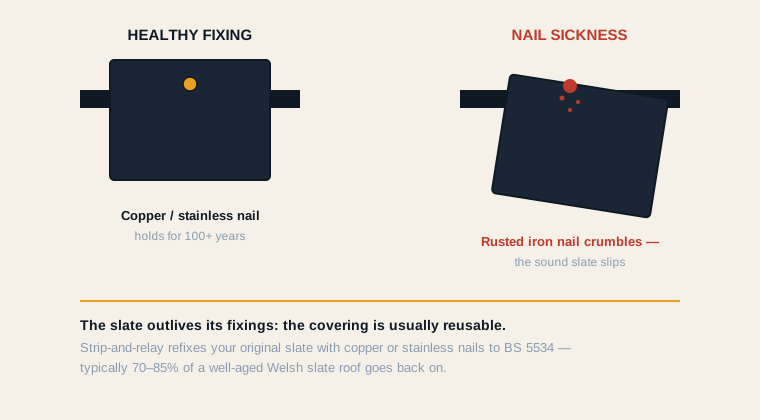
Fant, Tovil, Upper Stone Street and the town centre carry clay plain tile and Welsh slate that is 90 to 130 years old. Here the covering usually outlives the fixings, and the question is almost never whether the slate is finished.
Where nail sickness is localised, selective re-nailing in copper reuses the original material and buys 20 to 30 years for a fraction of a re-roof. Where it is widespread across every slope, stripping and re-laying is the answer — but that is still often re-laying the original slate rather than buying new.
The scatter pattern is the diagnostic. Tiles arriving intact rather than broken, from several areas rather than one, means fixings. Broken tiles from a single area usually means impact or a localised defect.
Bearsted, Loose, Barming and Allington carry substantial 1930s stock where the original bitumen felt is now ninety years old. Felt of that age has typically failed at the eaves and often delaminated mid-slope.
Failed felt does not leak on a dry day, which is why these properties pass a casual look and then admit water in the first wind-driven rain. Re-covering is the only real fix — you cannot replace felt without stripping the tiles — so the decision here is usually about timing rather than whether.
If your roof is under thirty years old, has isolated faults, no nail sickness and sound felt, a re-roof is oversell however confidently it is quoted. We will quote the repair and tell you to come back in a decade.
The same applies to a roof condemned by someone who never went in the loft. Nail condition and felt state cannot be assessed from a driveway, and a replacement recommendation made without that evidence is a guess at best.
We also decline work on roofs that need nothing. A survey concluding that the covering has fifteen years left is a perfectly good outcome and it costs you nothing to hear it.
The mirror image matters just as much. Three £300 repairs in eighteen months on a roof with widespread nail sickness buys nothing — the replacement cost does not reduce, and the interim spend is simply gone.
Re-bedding a ridge on a covering that is itself at end of life is the same error in miniature: money spent on the one part of the roof that was not about to fail.
Our threshold is roughly five years of remaining life and £300 a year of repairs. Below that, replacement is cheaper over any sensible horizon and we will say so even though the repair is the easier sale.
| Situation | Recommendation | Typical cost |
|---|---|---|
| Isolated fault, covering under 30 years | Repair | £150 - £900 |
| Localised nail sickness, sound slate | Selective re-nail in copper | £600 - £1,600 |
| Under 25% of tiles delaminated | Targeted repair, plan replacement | £150 - £900 now |
| Over 30% failed across slopes | Replace | £5,500 - £15,000 |
| Failed felt on 1930s stock | Re-cover (strip and re-lay) | £5,500 - £11,000 |
| Sound roof, no symptoms | Do nothing | £0 |
A free survey gives you the specific answer for your roof, in writing, with the reasoning stated. No deposit on repairs under £500; staged payments on re-roofs with nothing due before materials arrive. All prices include VAT.
Not sure which side of the line your roof sits? The survey is free and the answer is honest either way.
0162 229 6232Concrete tile from the post-war estates, clay or slate on Victorian stock, felt on flat sections — each has a different service life and a different failure curve.
One failed area is a repair. Failures appearing across several slopes at once usually means the fixings or the covering have reached end of life together.
Nail condition from the loft separates nail sickness from slate failure, and it is the single finding that most often changes the answer.
Repair cost divided by realistic years bought, against replacement cost divided by its expected life. The cheaper number per year wins.
Including, frequently, that nothing needs doing for another five years.
Replacement is the right call when the covering has reached the end of its service life, not when a single slope has a problem. The test is repair frequency against remaining years.
When it is not the answer: If your roof is under thirty years old with isolated faults and no nail sickness, a re-roof is oversell. We will quote the repair and tell you to come back in a decade. Read the full guide.
We measure the roof area and inspect rafter, batten and felt condition from inside before quoting.
Samples presented before ordering — concrete, clay or slate, with the cost and service-life difference explained.
Scaffold erected, old covering stripped, timbers exposed and assessed with you.
Breathable membrane replaces the old bitumen felt, new battens throughout, tiles mechanically fixed to BS 5534.
Chimney lead renewed, ridge mechanically fixed, roof photographed from scaffold and the ten-year guarantee issued.
| Job | Typical duration |
|---|---|
| Terraced property re-roof | 3-5 days |
| 3-bed semi re-roof | 5-8 days |
| Detached property re-roof | 7-12 days |
| Scaffold erection | Half a day, 2-3 days before start |
| Scaffold strike | 2 working days after completion |
A stripped roof is never left open overnight in forecast rain — we work in sections and sheet down each evening.
Every re-roof needs full perimeter scaffold. It is a named line in the quote, never a surprise extra. Scaffold is specified for: always — a re-roof cannot be done safely or compliantly without it - always itemised in your written quote, never a hidden extra, and we arrange it.
Victorian terraces around Upper Stone Street and Week Street have no side access, so materials go through the property or over the roof, and pavement scaffold needs a licence. Pavement scaffold and skip permits go through Maidstone Borough Council; allow a few working days on streets like Gabriels Hill, Bank Street, Earl Street, Upper Stone Street where space is tight.
| Job | Typical range | Notes |
|---|---|---|
| Concrete interlocking tile, semi-detached | £5,500 - £8,500 | Including scaffold and disposal |
| Clay interlocking tile, semi-detached | £7,500 - £11,000 | 60-80 year service life |
| Clay plain tile (conservation) | £9,000 - £13,500 | Reclaimed Kent tile matching |
| Natural Welsh slate, semi-detached | £10,000 - £15,000 | 80-100+ year service life |
| Detached property, concrete tile | £8,500 - £13,000 | Larger area, more complex geometry |
| Timber contingency (capped) | £400 - £800 | Only if found at strip |
Worked example: A three-bed semi on the Park Wood estate, 78m2 across two gabled slopes at 32 degrees with one stack: £6,200-£7,400 in concrete interlocking tile, including scaffold, skip, new battens, breathable membrane and a £600 capped timber contingency.
Repairs under £500 are paid on completion, no deposit. Larger works are staged, with no payment due before materials arrive. VAT included throughout.
Covering ME14, ME15, ME16 and surrounding postcodes.
Ten-year workmanship guarantee on the whole roof, with tile manufacturer warranties of 30-50 years and lead rated for 50-80 years on top.
If a fault appears in covered work, we come back and put it right. No quibbling, no re-charge.
Strip day is genuinely noisy and dust enters the loft. Move or cover anything stored up there before we start. Most families stay in the house throughout. You do not need to stay home for external work - we just need power and access agreed in advance.
Optimal window is late March through October. Winter re-roofs are possible but scheduled around the forecast in sections. The Medway valley holds humidity longer than the surrounding North Downs, so drying times run longer through autumn.
“Told us our roof had ten years left and to stop worrying about it. Another firm had quoted eleven thousand for a re-roof the week before.”
“Re-nailed the slate rather than replacing it. Half the price of the other quotes and they explained exactly why it was the right call.”
“Honest that patching ours was throwing good money after bad. Painful to hear but they were right, and the re-roof has been faultless.”
Repair if there are ten or more years of life left and faults are isolated. Replace if remaining life is under five years and repairs run over £300 a year, or if more than 30 per cent of the covering has failed.
A rule of thumb: once around 30 per cent of the covering has failed, repairs stop being economic because the material around each repair is failing at the same rate.
It needs a survey covering the roof surface and the loft. Nail condition, felt state and the proportion of tiles showing surface loss together give a reliable estimate.
Often yes. Welsh slate outlives its nails, so where the slate is sound, stripping and re-nailing in copper reuses the original material and adds 20 to 30 years.
No. Age alone is not decisive — condition matters as much. We assess the proportion of tiles with exposed aggregate rather than working from the build date.
Yes, and we do regularly. A survey concluding the roof has years left is a legitimate outcome and it costs you nothing.
It removes a liability rather than adding value in the way a kitchen does. On post-war estate stock at 50 to 65 years it removes a buyer negotiating lever and a mortgage retention risk.
The calculation changes. Sometimes a targeted repair programme that addresses visible issues is the commercially rational choice. We will price both scenarios so you can decide on numbers.
Free survey with a written recommendation and the reasoning stated, whichever way it goes.
0162 229 6232Lines open Mon–Fri 8am–6pm, Sat 8am–2pm · Emergency call-outs 24/7
More services: Chimney Repairs · Moss Removal · Fascias & Soffits · Lead Work · Slate Roofing · New Roof Cost · Roof Repair Cost · Flat Roof Cost · Roofline Cost · Gutter Cleaning · Chimney Repointing · Velux & Skylights · Storm Damage · Landlord Repairs · Commercial Roofing · Choosing a Roofer · Dry Verge & Ridge