Why the distinction decides everything
A damp report puts a landlord at a fork. Treat it as condensation and the response is advice on ventilation and heating, possibly an extractor fan. Treat it as building disrepair and the response is investigation and repair under section 11.
Getting that call wrong in the tenant's favour costs the price of an unnecessary fan. Getting it wrong in the landlord's favour costs a repeat complaint, an escalation, and eventually a disrepair claim in which the central allegation is that the landlord blamed the tenant for a defect in the building. The second error is considerably more expensive.
The honest position is that the two can look identical from a photograph, which is why a report of mould in a rental should trigger an inspection rather than a letter about opening windows.
How to tell them apart
Timing is the strongest single indicator. Water ingress from a roof defect appears during or shortly after rainfall and worsens with sustained rain rather than a brief downpour. Condensation appears in cold weather regardless of rain, and is worst after cold nights.
Location is the second. Ingress is localised, often on a ceiling or at the head of a wall, and produces staining with defined tidemark edges, frequently brown or yellow. Condensation concentrates in corners, behind furniture, on cold external walls and around window reveals, and produces black spot mould with a diffuse edge and no tidemark.
The third is the pattern over time. A leak stain grows during wet weather and dries out between, often leaving a visible ring. Condensation mould spreads steadily through winter and recedes in summer without ever showing a tidemark.
The Maidstone stock: where roof-sourced damp comes from
In the Victorian and Edwardian terraces of Fant, Tovil and around Upper Stone Street, the dominant cause is failed lead. Soakers at abutments and party walls, valley linings narrower than the 600mm BS 6915 specifies, and chimney flashings that are now over a century old. Water entering at these points tracks along battens and rafters before it drops, so the internal stain is often a room away from the entry.
On the post-war estates through Shepway, Park Wood and Senacre, guttering is the usual culprit. Overflow saturates the outer leaf of cavity brickwork until water bridges the cavity, then appears as internal damp at mid-wall height. Tenants and landlords both routinely misread this as rising damp.
In riverside Aylesford, Larkfield and Tovil, the Medway floodplain humidity means moss and organic growth block valleys and outlets faster than elsewhere in the borough, so the same defect produces ingress sooner.
The ventilation trap
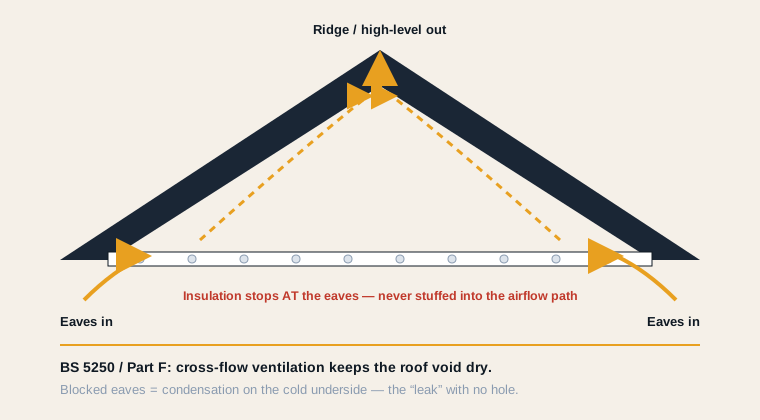
The most consistently misdiagnosed cause we attend in Maidstone rentals is blocked eaves ventilation. A great many properties in the borough have had loft insulation topped up under one grant scheme or another, and on a large proportion of them the insulation has been pushed hard into the eaves.
That blocks the airflow path from the eaves inlet to the ridge outlet, and the roof void becomes a moisture trap. Condensation forms on the underside of the felt, drips onto the insulation and the ceiling below, and produces damp and black mould in the top-floor rooms.
It presents exactly like occupational condensation and it is a building defect the landlord is responsible for. The fix is cheap — pull the insulation back from the eaves and fit baffles to maintain a 50mm clear air path — but only if someone looks. We check eaves ventilation on every damp investigation for this reason.
What a proper damp investigation involves
External inspection of the roof covering, flashings, valleys, guttering and downpipes, looking for the defect rather than confirming a theory. Internal inspection of the affected room, recording the pattern, edges and location of the staining. Loft inspection for daylight, felt condition, wet insulation and blocked eaves.
Where the picture is ambiguous, timing the return visit to coincide with sustained rain settles it faster than any meter. A patch that is dry after four dry days and wet after two wet ones is not condensation.
The output is a written report stating the cause, not just the symptom. That is the document that supports the landlord's next step, whether that is a repair instruction or a properly evidenced conversation with the tenant about ventilation.
The compliance backdrop
Awaab's Law brought binding investigation and remedy timescales into social housing from 27 October 2025. It does not yet apply to private landlords — the Renters' Rights Act 2025 provides the power to extend it as Phase 3, with no confirmed date and a consultation promised first.
That does not make damp a low-priority item for private landlords. The Homes (Fitness for Human Habitation) Act 2018 already lets a tenant bring a direct claim where damp makes a property unfit, and serious mould is squarely within the hazards that test looks at.
The practical takeaway is that the direction of travel is one way. Landlords and agents in Maidstone who put a damp-response process in place now — triage, prompt inspection, documented cause, fix at source — are doing what the law will require anyway, and defending themselves under the law as it already stands.
What we do on a Maidstone damp instruction
We contact the tenant directly and arrange access with time windows rather than all-day slots. We inspect externally, internally and from the loft, and we check the eaves ventilation as standard.
You receive a written report with photographs stating what is causing the damp, including where the answer is that the roof is sound and the cause is occupational. Where it is a roof defect, we quote the repair separately and itemised.
Where the cause is genuinely mixed — a minor building defect plus high occupational moisture, which is common in HMOs — we say so plainly. That is the report that actually helps, because it lets the landlord fix their part and evidence that they did.
The tenant conversation, done properly
Where an inspection establishes that the cause is genuinely occupational — drying washing indoors, no extractor use, heating turned off in unused rooms — the landlord still has to have that conversation, and how it is handled affects whether it escalates.
What does not work is a letter asserting lifestyle causes without having inspected. It reads as a brush-off, it is frequently wrong, and it is the single most quoted document in disrepair claims because it demonstrates the landlord decided before looking.
What does work is sharing the inspection report. A document that says the roof covering, flashings and eaves ventilation were all checked and found sound, with photographs, and that the pattern of mould is consistent with condensation, is a very different proposition. It gives the tenant something concrete and it evidences that the landlord took the report seriously.
Mixed causes are the norm, not the exception
The framing of damp as either roof defect or tenant behaviour is a false binary that suits neither party. In practice a substantial share of cases in Maidstone rental stock are both: a minor building deficiency that would be tolerable in a well-ventilated home, combined with occupancy that generates more moisture than the property can shed.
A blocked eaves vent alone might produce nothing visible in a lightly occupied house. Add four occupants in a converted Victorian terrace in Fant with no extractor in the bathroom and the same defect produces mould within a winter.
The correct response is to fix the landlord's part and be specific about the rest. A report that says the eaves ventilation was blocked and has been remedied, and that an extractor fan in the bathroom would materially reduce the remaining risk, is honest and actionable. It also removes the landlord's exposure, because they have addressed the defect they own.
Cost of getting it wrong
The economics favour investigating properly by a wide margin. A damp investigation on a Maidstone rental is £150 to £300 and produces a written cause. A gutter clear or eaves baffle installation, which is what a good proportion of investigations conclude with, is £80 to £200.
Against that, the cost of a repeat complaint cycle is a series of call-outs achieving nothing, then remediation of ceilings and decoration once the water has been coming in for a season, then in the worst case a disrepair claim with damages, the tenant's costs and the landlord's own.
Insurers are also increasingly interested. A claim for water damage where the underlying defect was reported and not investigated is precisely the scenario an insurer will examine, and a documented investigation is what closes that line of enquiry.
Key FactBuilding Regulations Approved Document F requires roof void ventilation equivalent to a continuous 10mm gap at the eaves. Blocking that path with loft insulation is a common cause of condensation-driven damp that is frequently misattributed to tenant lifestyle rather than building defect.
Last updated: August 2026